About
Graphite is a research-driven digital growth agency specializing in SEO and Answer Engine Optimization (AEO). They do original research to inform strategy and help build growth programs for leading technology companies like Notion, Webflow, Rippling, Masterclass, OpenAI, Netflix, Adobe, and Meta.
Industry
Digital Marketing & Growth Agency
Company size
200+ employees
Headquarters
San Francisco, California
Founded
2015
Specialties
Search Engine Optimization, Answer Engine Optimization, Content Strategy, Original Research, Growth Marketing
See it for yourself
Book a demo and see a live, customer-specific account rebuilt into the complete record every GTM team can trust.
Request demo
Ethan Smith
CEO & Founder
Full-Journey Attribution Revealed the Real Channels Driving Graphite's 100% Inbound Revenue
53% of Deals from Referrals
Over half of deals in the past 2 years came from referrals — almost none of which showed up in standard systems
$10M+ Referral Revenue Uncovered
Full-journey attribution traced relationships invisible to traditional CRM tracking
Events Restarted After Data
Graphite had stopped events based on bad attribution data. Upside revealed events were a core growth flywheel
From invisible referrals to a data-driven growth playbook: Upside revealed the hidden engines behind Graphite's revenue.
- Referrals Quantified for the First Time: 53% of deals — over $10M — traced to ~20 distinct referrers whose influence was completely invisible in the CRM. Upside looked at emails, call transcripts, and SFDC notes to find every referrer.
- Events Restarted After Data Proved Their Value: Graphite had stopped events because attribution showed zero impact. Upside revealed events fuel the referral flywheel — the people referring the most deals had attended Graphite events. Events were restarted immediately.
- The "Ethan Channel" Quantified: Created a dedicated attribution channel for the CEO's thought leadership, confirming his outsized revenue influence while surfacing key-man risk that needs diversification.
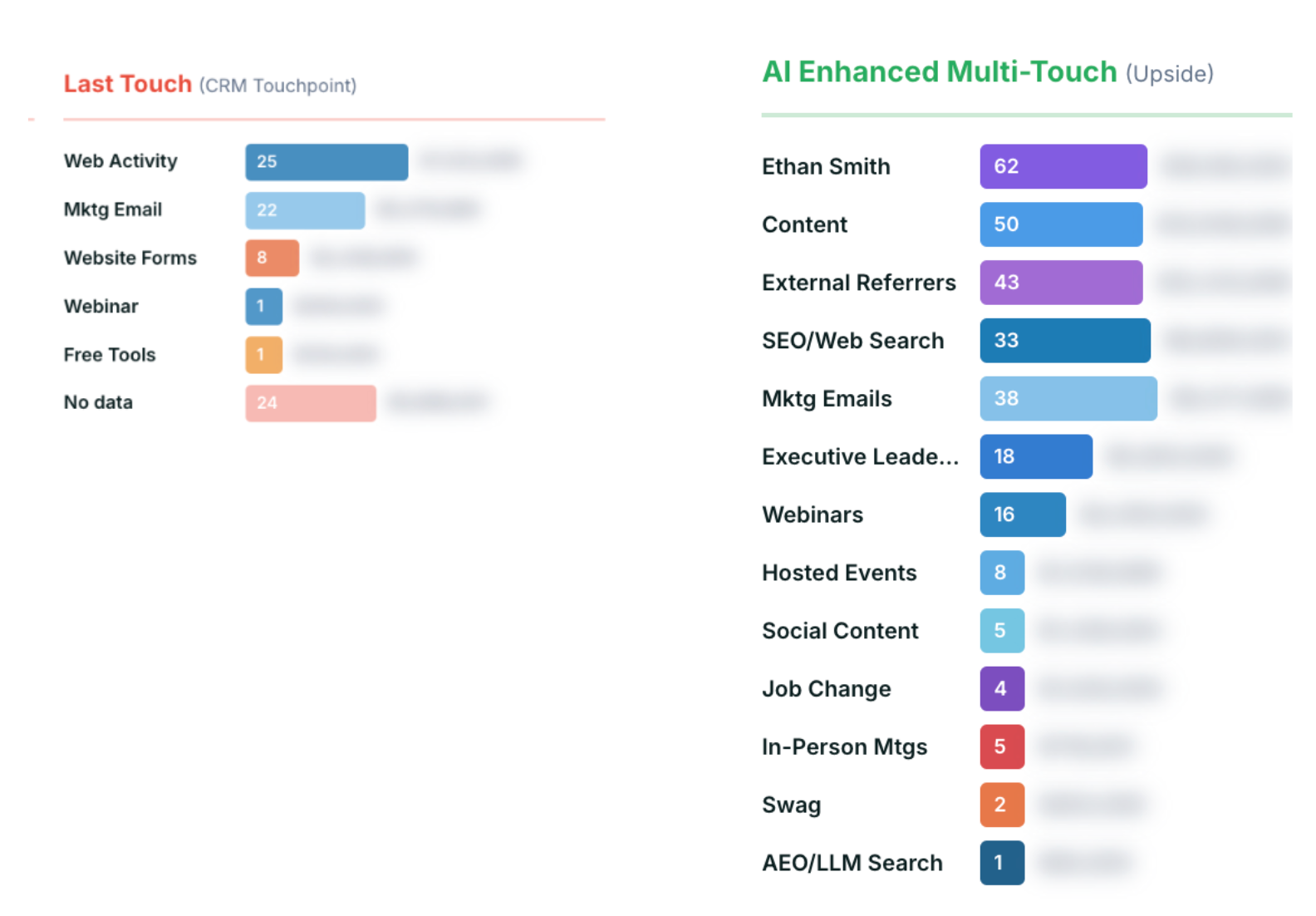
- Last-Touch Attribution Debunked: Traditional models said "send more emails, get more form fills." Upside's full-journey analysis told the opposite story — referrals, events, and thought leadership are the real growth engine.
- 8 Lost Deals Recovered: Identified deals initially closed-lost that came back and closed as won — many through referral relationships that developed over years.
A $15M+ Agency Built Entirely on Inbound — With an Unconventional Playbook
Graphite has built $15M+ in revenue entirely through inbound channels — with zero outbound sales, no cold email, a marketing team of 4, and a sales team of 2. Neither salesperson had any sales experience, they moved to sales from practitioners roles. Everyone at the company is a practitioner who also happens to do marketing and sales.
CEO Ethan Smith's approach to growth defies conventional wisdom at every turn. Where the typical marketing playbook says post daily on LinkedIn, run paid ads, produce content hubs and video shorts — Graphite does almost none of these. Instead, they've built a business on a radically different set of channels: original never-been-done-before research from PhDs, authentic bespoke events with no sales pitches, premium bespoke swag given on special occasions only, and leadership that personally writes everything.
The results speak for themselves. Graphite works with companies like Notion, Webflow, OpenAI, Netflix, Adobe, and Meta. 53% of their deals in the past two years came from referrals. A single Lenny's Podcast episode directly influenced over $1.5M in closed-won revenue. Ethan's LinkedIn posts — written once a month, maximum length, packed with original research — regularly generate 4,000+ likes.
But Graphite had a measurement problem. Their unconventional channels — thought leadership, referrals, intimate dinners, premium swag — were largely invisible to traditional marketing attribution.
When Traditional Attribution Tells the Wrong Story
When Graphite first started working with Upside, the initial attribution reports painted a misleading picture. Traditional last-touch and first-touch models showed only three things driving revenue: web activity, marketing email, and website forms. A significant number of deals appeared to have no attribution data at all.
Under a last-touch model, 100% of the credit goes to whatever happened right before conversion — typically an email or a form fill. The recommendation from this data: send more people to the website, send more emails, get more people to fill forms. This is the standard marketing playbook — and it would have been exactly wrong for Graphite.
The real problem was that Graphite's most powerful channels operate outside the boundaries of what traditional attribution can see:
- Referrals happen through personal relationships built over years — sometimes a decade — and never through a tracked link
- Events create influence through authentic connection, not campaign URLs. Guests weren't always added to CRM campaigns
- Thought leadership drives deals when a CMO hears Ethan on Lenny's Podcast and reaches out on LinkedIn — a touchpoint that never hits a UTM parameter
- Premium swag (custom graphite mechanical pencils from an English manufacturer) generates enthusiastic responses that correlate with referrals — but lives entirely outside digital tracking
Worse, acting on the incomplete data nearly led to a strategic mistake. Graphite stopped doing events because the numbers didn't show they were working. The data wasn't wrong, the attribution model just couldn't see the impact.
Full-Journey Attribution Reveals What Really Drives Revenue
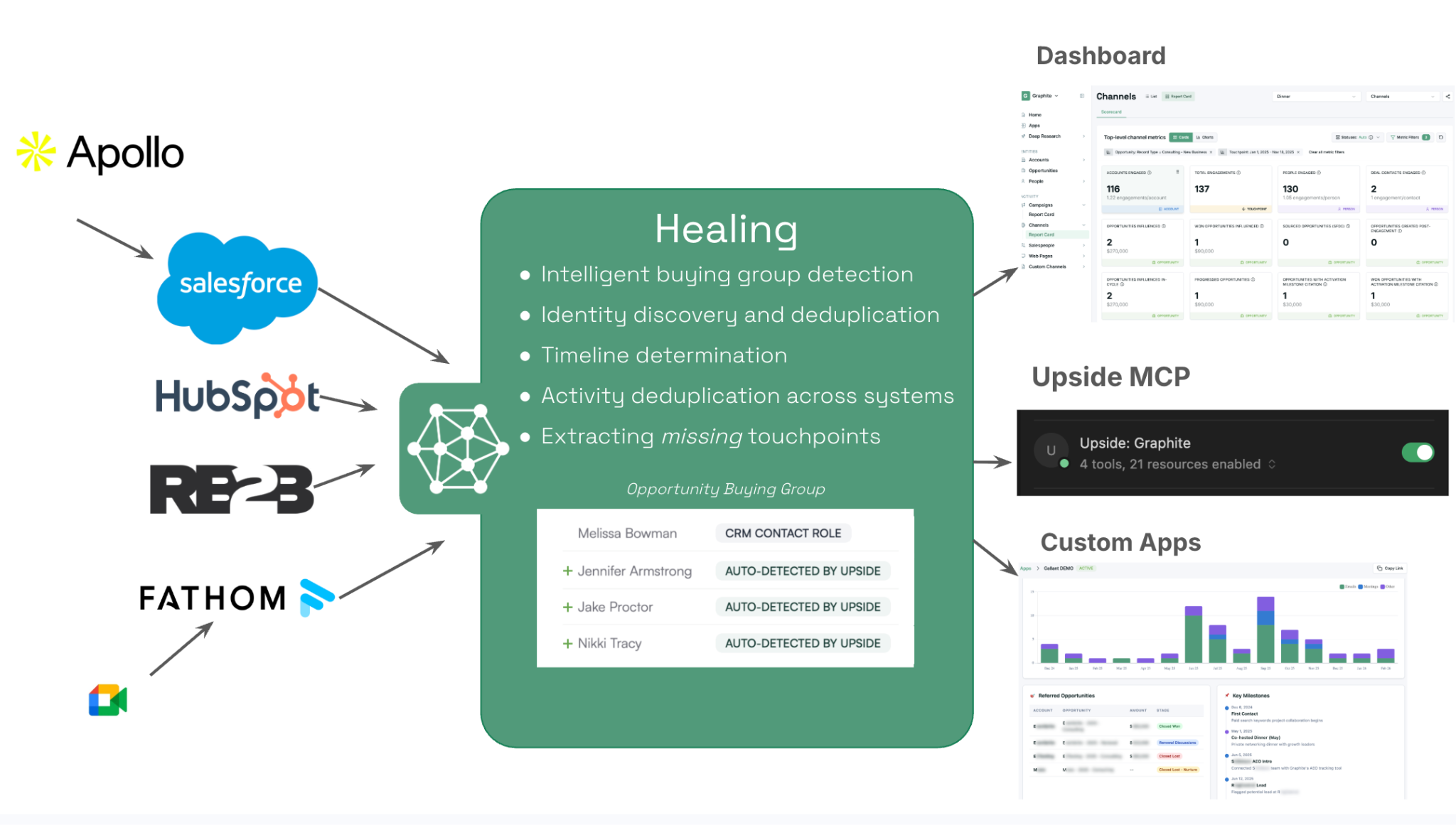
Upside connected all of Graphite's data sources — Salesforce, HubSpot, Apollo, Fathom call transcripts, RB2B anonymous traffic data — into a unified knowledge graph. Rather than relying on simple first-touch or last-touch credit, Upside used AI to extract missing touchpoints from call transcripts and emails, perform intelligent buying group detection, and recover persona identifications that weren't properly tracked in the CRM.
1. Referrals: The $10M+ Hidden Engine
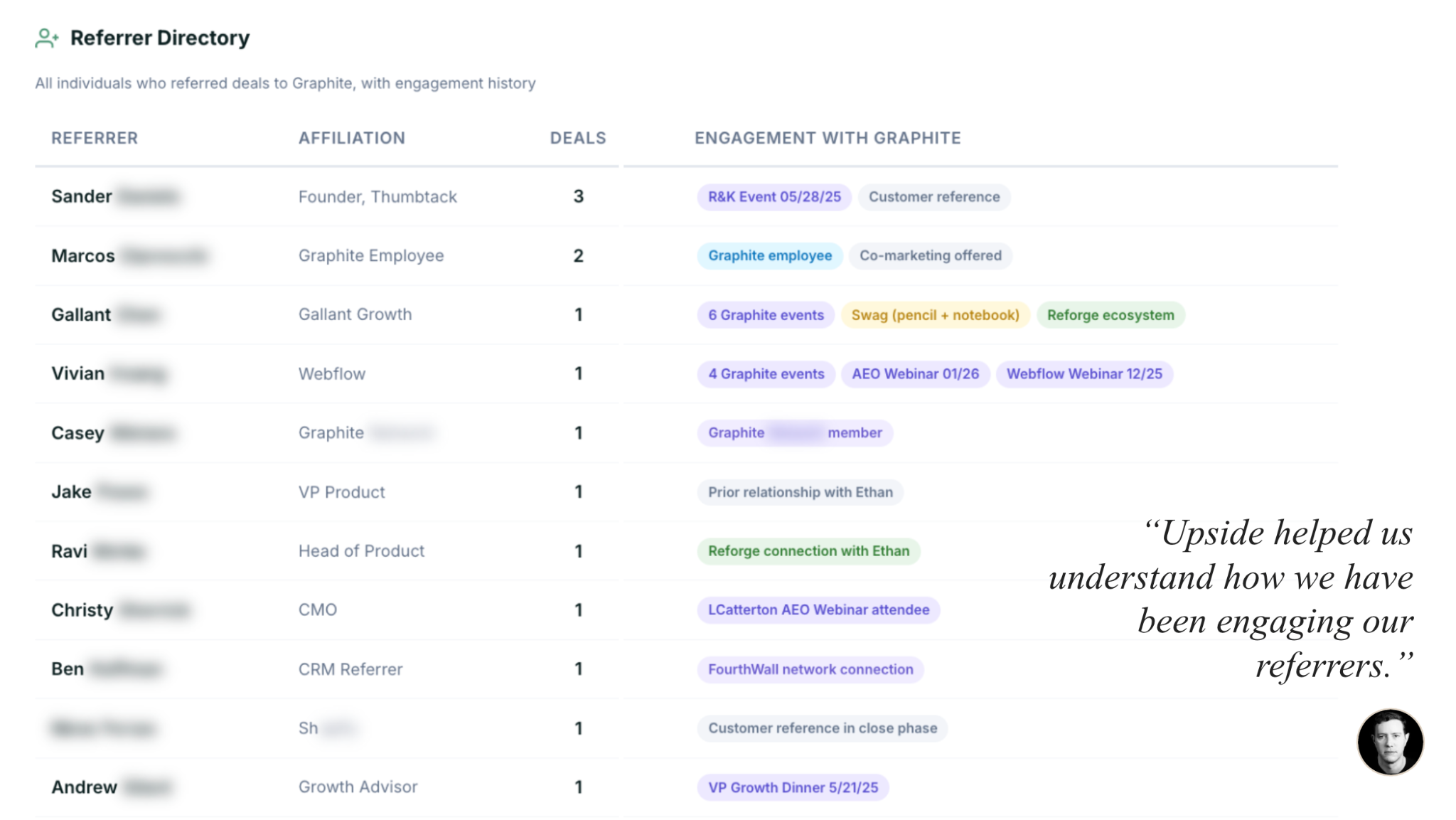
Upside's analysis revealed that 53% of Graphite's deals in the past two years came from referrals — and almost none showed up in standard systems. Across 40 closed-won deals, referrals directly influenced over $10 million in revenue. These referrals were invisible in Graphite's CRM because they happened through personal conversations, dinners, and professional networks rather than tracked links.
The data uncovered approximately 20 distinct referrers, each contributing one to three deals. These weren't transactional referral program participants — they were people whose relationships with Ethan spanned years, sometimes over a decade, before generating the first deal. As Ethan describes it: "We never ask anyone for a referral. Everything is people coming to us and hearing about us from somewhere other than us reaching out to them."
"We had no idea how many people were referring deals to us. Upside looked at all of the data and showed us the full picture." — Ethan Smith, CEO & Founder, Graphite
2. Events: From "Not Working" to Core Growth Flywheel
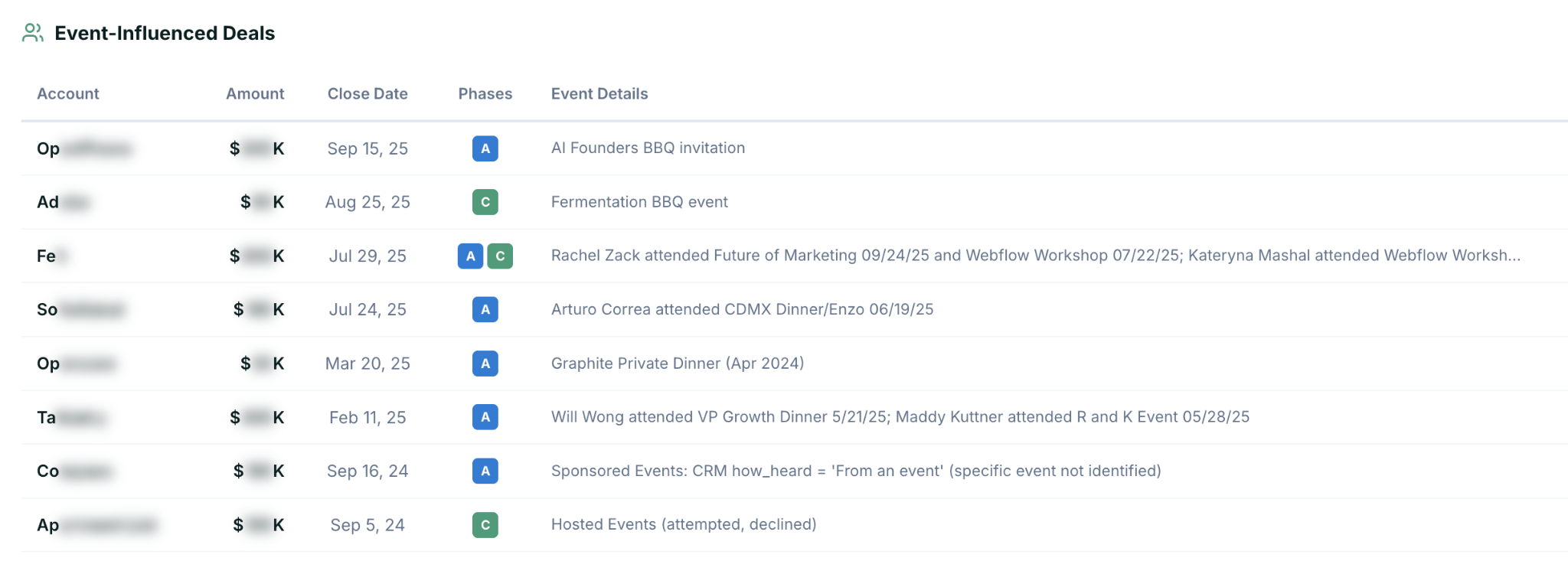
This was perhaps the most consequential insight. Events didn't show up in first-touch, last-touch, or even regular multi-touch attribution at all. Not all attendees were added to CRM campaigns. Traditional models simply could not see their impact. The conclusion seemed clear: events weren't driving revenue.
Graphite stopped doing events based on this data.
Upside's full-journey analysis told a completely different story. By looking through call transcripts and emails, Upside found multiple deals where prospects explicitly mentioned attending a Graphite dinner as a key moment in their decision process. More importantly, when Upside mapped the referral network, a pattern emerged: the people referring the most deals were often people who had attended Graphite events. Events weren't directly converting attendees into customers — they were fueling the referral engine that drives 53% of Graphite's revenue.
Upside also revealed that events help Graphite build champions — people who become long-term advocates. When those champions change jobs, they bring Graphite with them (accounting for 4 additional deals). Events create a compounding flywheel of referrals and champion-building that is invisible to any single-touch attribution model.
Ethan's events are distinctly authentic — he personally cooks everything from farmer's market ingredients, makes the cocktails, and hosts in his own garden. There are no salespeople, no pitches. The follow-up email contains a list of attendees, a summary of the conversation, and links to photos — nothing more.
With this data in hand, Graphite has now restarted their event program, armed with a much better understanding of how events create long-term value through the referral and champion flywheel.
3. External Webinars: Closing Deals, Not Just Building Awareness
Traditional attribution often treats content and thought leadership as top-of-funnel awareness channels. Upside's analysis revealed something dramatically different for Graphite.
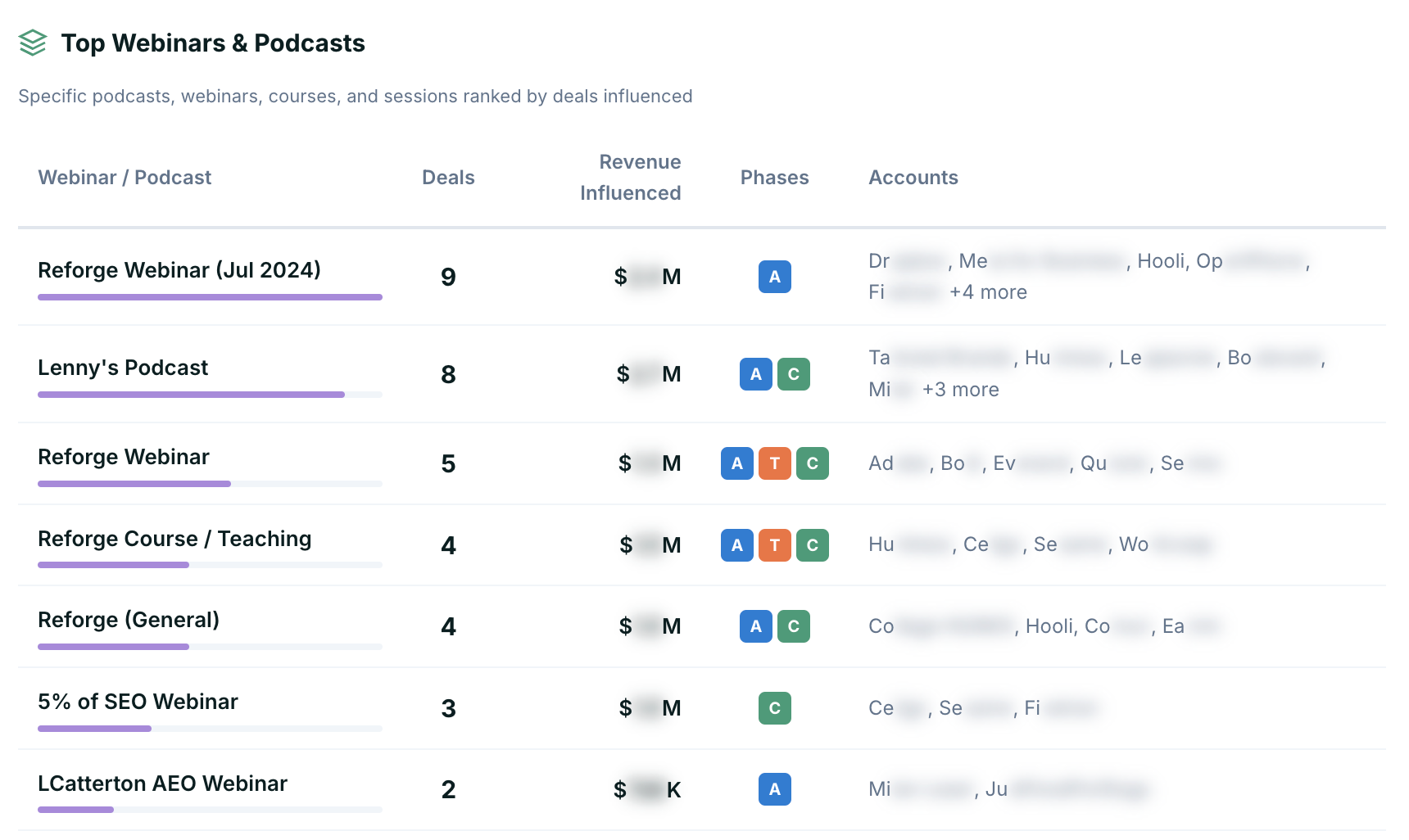
What made these webinars effective is the same philosophy Ethan applies everywhere: every single webinar features unique information he hasn't shared before, with live demos and practical takeaways rather than static slides.
4. Deal Recovery: Pricing Objections That Resolved Themselves
Upside uncovered another hidden pattern: 8 deals that were initially closed-lost later came back and closed as won. Many of these were originally rejected on pricing. The data showed that as Answer Engine Optimization (AEO) became a hot category alongside traditional SEO, the perceived value of Graphite's services increased — changing the pricing equation without Graphite having to do anything differently.
5. The CEO Channel: Quantifying What Everyone Suspected
One of the most distinctive findings was the creation of an "Ethan Smith" channel in the attribution model. Upside's analysis confirmed what Graphite already sensed — Ethan's personal thought leadership drives a significant portion of revenue. His LinkedIn posts (infrequent, maximum length, packed with original research) outperform most daily posters. His podcast appearances create immediate pipeline. His personal relationships generate referrals.
This data validated the importance of Ethan's role but also surfaced the key-man risk — as Ethan himself acknowledges: "I am the Kim Kardashian of answer engine optimization. But we need more Kardashians." Upside's data is now helping Graphite plan how to diversify thought leadership across the team while maintaining the authenticity that makes it effective.
What Ethan Plans to Do Next
Armed with Upside's full-journey attribution data, Graphite is doubling down on the channels that actually drive their business:
- Resuming Events: With better follow-up processes and co-hosting partnerships, knowing events fuel the referral and champion flywheel
- Expanding the Referral Flywheel: Proactively (but authentically) engaging their top 20+ referrers — starting with sending premium pencil swag
- Diversifying Thought Leadership: Developing other team members as content creators and subject matter experts to reduce CEO dependency
- Investing in Premium Webinars: Continuing to create unique content for every external appearance, with live demos and practical takeaways
- Using Upside's MCP Integration: Querying attribution data directly through Claude for self-serve insights without bottlenecks
"Finding hidden touchpoints and fixing the data tells a very different story about what we should focus on. We were able to show Graphite channels that aren't just touching deals, but channels that actually drove meaningful engagement." — Mada Seghete, CEO & Founder, Upside