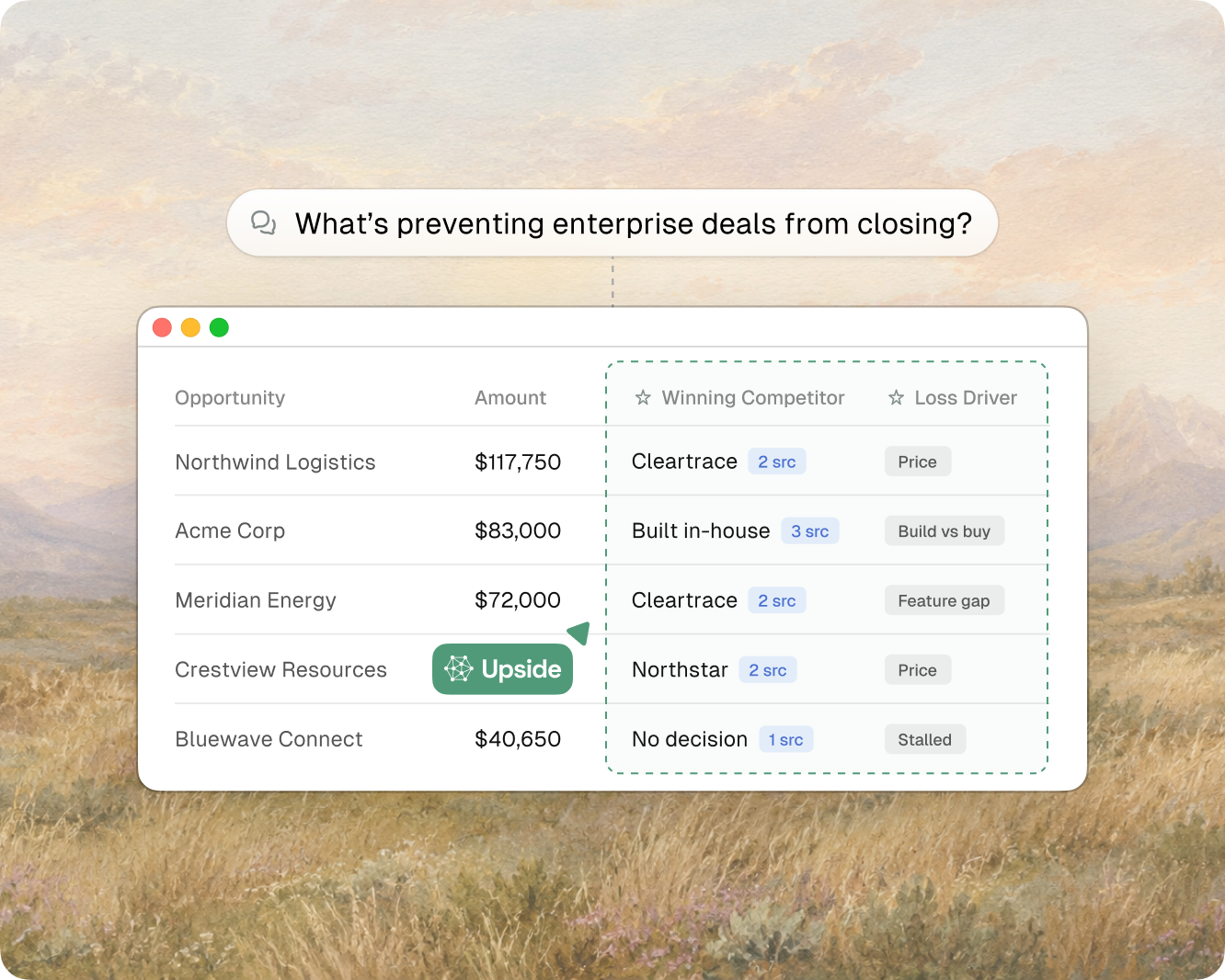
Ask one question across a whole cohort of deals. Upside reads the calls, emails, and CRM records for every record, then returns the answer as cited, queryable columns.
The answers live in calls, emails, and notes, but pulling them out meant weeks of manual reading. The questions that mattered went unasked.
Reading it the old way
Deep Research
✕Dashboards and BI report only on structured CRM fields
✓Reads structured and unstructured data together: calls, emails, notes, fields
✕A qualitative question means an analyst reads records one by one
✓Runs the same question across the whole cohort at once
✕The answer is a one-off deck, stale the day it ships
✓The answer lands as structured fields you can filter, join, and query
✕”Trust me, I read the calls” with no way to check
✓Every value cites the evidence it was drawn from
How it works
How it works
The same four steps run on a cohort of any size, from a single account to every closed deal in a quarter.
1Define the question
Closed Lost, Q438 opps
2Run across the cohort
38 parallel runs
3Read every source
SalesforceGongemailnotes
4Land as cited fields
citedqueryable
Most losses were to in-house builds, not a competitor.
The four steps on the real worked example: a closed-lost question becomes a cited field on every deal, and the cohort rolls up to a finding leadership can act on. The roll-up sentence is a sample synthesis on demo data, marked illustrative. Hooli demo org · sample report.
AI fields
Turn a question into a column.
AI Fields are user-defined, AI-computed columns. Describe what you want to know in plain language, and Upside computes it across every matching record from the calls, emails, and CRM history, then stores the result as structured data you can filter and aggregate like any other field.
Defined in words, returned as data.“Did this deal include a security review?” or “Which competitor was mentioned?” goes in as a sentence; the output is a queryable value on every record.
Materialized, not trapped in a chat.Values land in the data model per entity, so you can filter a closed-lost set by winning competitor the same way you filter by deal size.
A new dimension without an engineering sprint.Analysts add fields directly. The analytical surface grows as fast as you can describe what to measure.
Consistent across the whole set.The same definition runs on every record, so the column means the same thing in row 1 and row 500.
CRM · Loss Reason(blank)
Gong · Nov 28“…move forward with Cleartrace for the rollout.”
Email · procurement, Dec 2“…Cleartrace already approved on the MSA.”
Winning competitorCleartracecited · 2 sources
How one AI-field cell gets computed: the structured CRM field is empty, but the answer is in a call and an email. Upside synthesizes the value and keeps the citations. Competitor name is a sample value. Hooli demo org · sample values.
Templates
Pre-built analyses, no methodology to design.
Some answers do not need a custom field, they need a standard analysis. Template Analyses ship the methodology and the infrastructure, so a team can run a real analysis the same day they onboard, on demand, in bulk across a filtered set, or on a schedule against new records.
Milestone Analyses
The story of the key moments leading up to an opportunity’s activation: what drew the buyer in, who got involved, and which channels and campaigns contributed, drawn from calls and emails rather than CRM fields. It ships with touchpoint, channel, and campaign citations as structured columns.
Direction Analyses
A computed direction tag on each deal: inbound, meaning they came to you, or outbound, meaning you went and found them. Backed by the same evidence and stored as a queryable dimension you can filter and group by.
Ascend Academy · $117,750
Drawn in by a Q3 webinar; single-threaded until the proposal. Price raised on the Nov 28 call.
The influences become dashboard metrics.Because every milestone analysis cites its channels and campaigns as structured columns, the dashboard rolls them up: see every opportunity where a given campaign or channel was cited in a milestone analysis, and track that count as a metric like any other.
The methodology is built in.Each analysis type ships with its method and infrastructure already validated, so you get a real analysis the day you onboard instead of a project to design first.
Receipts
Built to be trusted at scale.
Qualitative analysis is only useful if you can trust it without re-reading the source, and if it holds up across hundreds of records, not just the first few. Every value Upside computes carries its evidence and lands as real data.
Cited to the source.Each field and analysis links to the specific calls, emails, and records it was drawn from, so any value can be checked in one click.
Consistent at scale.Each record is its own parallel job, so a cohort of hundreds reads as cleanly as a cohort of three, instead of one agent drifting as it grinds down a long list.
An opinion you can audit.Outputs carry a stated read, not just a label, so a reviewer can see why the analysis landed where it did.
Structured, not prose.Results land as real columns you can filter, sort, and join against pipeline data, in the dashboard or over MCP, not a one-off spreadsheet.
Auto-refresh.COMINGA report keeps itself current as new records match its criteria, instead of being a point-in-time snapshot.
Winning competitor
38 closed-lost deals
Built in-house
11
Cleartrace
9
No decision / stalled
7
Northstar
6
Other / unclear
5
The cohort rolled up to a finding, with the audit trail intact: the bar is the pattern, but every count traces back to cited deals and the exact transcript line. Sample counts on demo data, marked illustrative. Hooli demo org · sample values.
Proof
What teams found when they asked.
Two questions a dashboard could never answer, and what the work turned up.
Case study
Every QBR now runs on Deep Research.
Cresta replaced weeks of manual Gong-transcript review with Deep Research that scores every deal and surfaces why it moved. The work that used to take an analyst weeks now lands in about a day, and it powers every Quarterly Business Review.
Running Deep Research across the buyer journey surfaced a complete milestone analysis from Gong that Salesforce never showed, and turned up 30k+ previously hidden contacts and a brand-new AEO growth channel the team had never tracked.
“
We are able to see a complete milestone analysis with data pulled from Gong we wouldn’t ever be able to see in Salesforce.
Deep Research reads from the one reconstructed record every Upside product shares, and its outputs flow back into the surfaces the team already uses, so a finding can be checked against the deals behind it.
Runs on
Data Foundation
The unified, healed history of every account: calls, emails, fields, and buying groups that the analysis reads from.
Putting it to work? See how teams use it for account and deal intelligence. Explore the use case →
FAQs
Questions? Answers.
The practical details, and where this fits alongside the systems your team already runs.
How is this different from our BI tool or dashboards?
BI reports on the structured fields your CRM happened to capture. Deep Research reads the unstructured record too, the calls, emails, and notes where most of the real signal lives, and turns it into structured fields you can then report on. It runs upstream of BI, not instead of it: the columns it produces are joinable with everything you already analyze.
Does this replace our analyst?
It does the part that never scaled: reading every record. Your analyst stops spending weeks tagging transcripts and starts working from a cohort that is already structured and cited, asking the next question instead of doing the manual pass first.
How do we know the answers are right?
Every value cites the specific calls, emails, and records it was drawn from, and carries a stated opinion rather than a bare label. You can check any cell in one click, and because the same definition runs on every record, the column means the same thing across the whole set.
Can it handle a large cohort without the quality dropping off?
Yes. Each record is analyzed as its own focused job, run in parallel, so the last deal in a set of hundreds gets the same depth as the first. That is the difference between a real cohort answer and a summary that thins out toward the bottom.
What does it need from us to run?
It runs on the Upside data foundation. Connecting your systems is an OAuth step, not a data-engineering project, and once your calls, emails, and CRM data are flowing you pick a cohort and a question and the analysis runs.
Ask the question you stopped asking.
Bring a cohort you have always wondered about, a quarter of closed-lost deals, a segment that keeps stalling, and watch the answer come back as cited data.
 Case study
