An active context layer for your agents.
Most institutional-knowledge layers are passive stores an agent has to remember to read. Radiant is active: it fires before any agent touches your Upside data, coaches each query with how your organization’s data actually works, and remembers what it learns, so the tenth question lands better than the first.
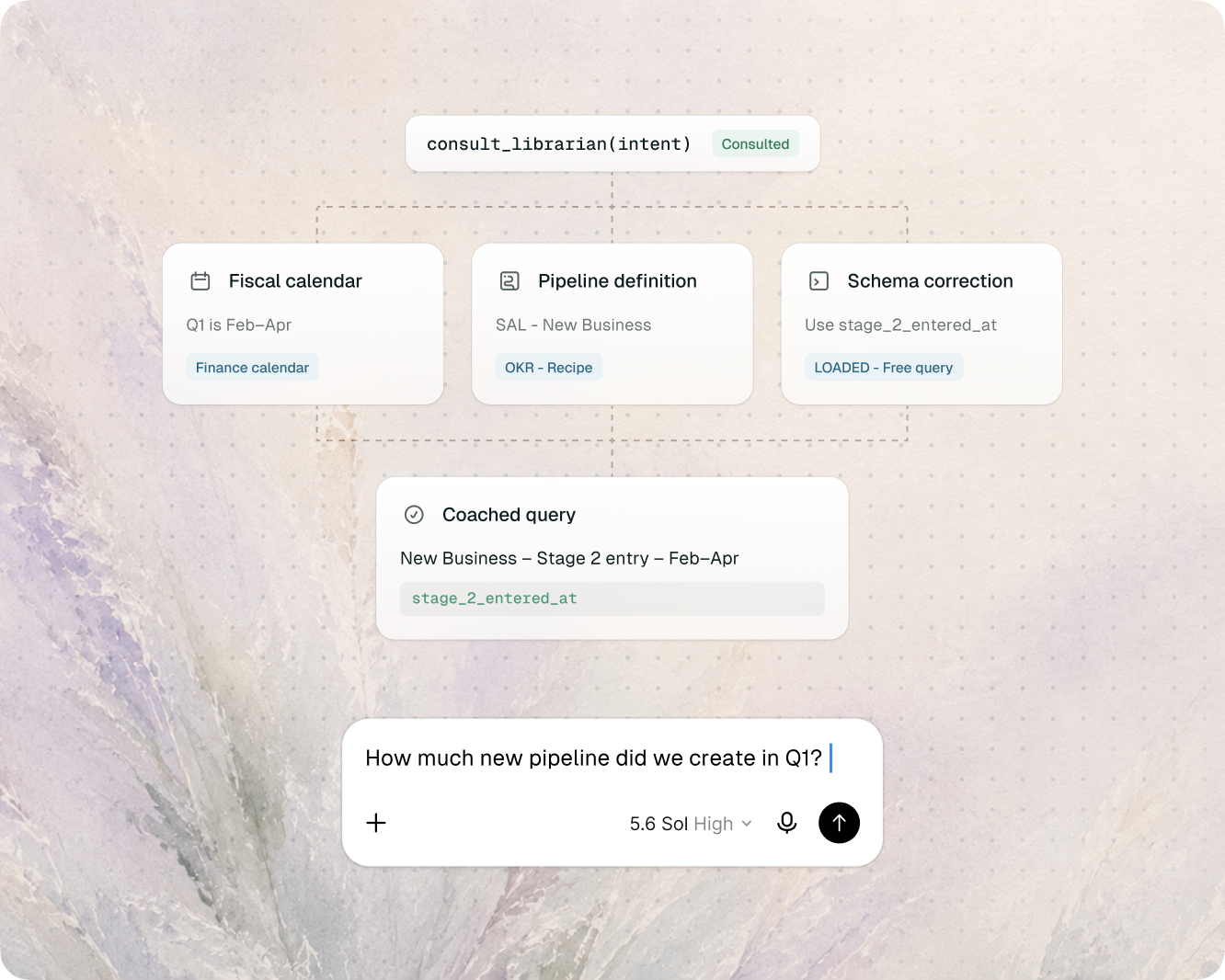
Teach every agent how your data works.
An off-the-shelf AI model knows the textbook definition of a stage, a segment, or a fiscal quarter, but not yours. It returns a clean number that’s wrong, and no one catches it.
Generic priors, specific errors. Field values that exist in Salesforce but aren’t used by your organization. A fiscal year that starts in February. A “qualified” stage that means something different on your pipeline than the default. None of it is in the model’s training data.
The knowledge lives in people’s heads. The one analyst who knows the gotchas can’t sit in every agent’s context window. A pasted data dictionary goes stale the week after someone writes it, and only helps the person who pasted it.
Wrong is worse than slow. An agent that’s confidently wrong erodes trust in every answer that comes after it. The failure isn’t an error message; it’s a plausible number with no warning label.
It compounds the more you use AI. Every new client, every new teammate, every new automation starts the briefing over from scratch, unless the context lives somewhere the agents can reach on their own.
A coach, not a lookup.
Instead of hoping the agent already knows your conventions, Radiant makes the agent state its intent, then coaches it toward the right answer.
Calling Upside’s MCP triggers Radiant automatically. The agent states its intent and gets back the org-specific facts that matter for this query: definitions, field semantics, and assumptions that would have produced a silent error.
Platform conventions and your organization’s ground truth combine, and your org’s definitions take precedence over the platform defaults. The agent works from how your team actually defines things, not from a generic assumption.
When a query fails or returns nothing, Radiant appends what it knows about why that class of query tends to break for your org, so the agent’s next attempt is informed instead of a blind retry.
Platform · all orgs
Default touchpoint types, channel taxonomy, standard stage names.
overriddenYour organization
Fiscal year starts Feb 1 · “New pipeline” = Stage 2, New Business · renewals excluded.
wins ✓Everyone works from the same definitions.
AI insights are never word-for-word identical, but when two people ask the same question and get meaningfully different answers, that's a problem. With Upside, every agent consults Radiant first. So they start from the same fiscal calendar, the same stage and segment rules, and the same field meanings.
“New pipeline in Q1?”
“How much Q1 pipeline did we create?”
“Q1 new-business pipeline?”
 Radiant
Three ways Radiant keeps agents right.
Three capabilities, one active context layer. Each makes the agents you already use more correct about your business, without anyone having to remember to brief them.
The consult step isn’t a suggestion the client can skip. It’s enforced before a query runs, so coaching happens by default, not when someone remembers to ask for it. The same librarian reaches Claude, Cursor, and Upside’s own agent.
Add a fact the moment you hit the need for it, from inside the same AI workflow, no separate tool. Entries are tagged, versioned, and tied to the query or document that confirmed them. Memory persists across sessions, so multi-week work picks up where it left off.
A background agent reads how agents have worked with your data, the questions, the failures, the corrections, and proposes candidate entries from the patterns. Every proposal lands in the same review queue. The agent proposes; a person approves.
Knowledge library · Acme Co
v14 · 218 activeWhat Radiant stands on.
Radiant coaches against the same reconstructed record the rest of Upside runs on, and reaches your agents through the same open interface.
Every call to Upside’s MCP triggers Radiant first, so coaching reaches any connected client.
The unified, healed record and your org’s conventions are the ground truth Radiant teaches agents about.
Curate the knowledge library and review the queue from the same place your team explores accounts.
Building agents and workflows on your GTM data? Radiant is the layer that keeps them correct. See AI-native GTM workflows →
Questions? Answers.
The practical details, and where this fits alongside the systems your team already runs.
How is this different from other context-layer products?
Most context layers are passive: a knowledge store an agent has to remember to query, that returns whatever it is asked for. Radiant is an active agent. Before any query runs, Radiant works out what this agent needs to know for the task in front of it and delivers that coaching automatically, whether or not the agent thought to ask. The difference is a reference shelf versus a librarian who stops you on the way in and asks what you are trying to do.
How is this different from the memory built into Claude, Codex, and other AI tools?
Those memories live inside one tool and one user’s account. They remember your past chats, not your company’s data conventions, and nothing carries over to the next tool or the next teammate. Radiant is model- and client-agnostic: a shared, active context layer that sits behind Upside’s MCP, so the same coaching reaches Claude, Cursor, Codex, and your own agents. Radiant holds your organization’s ground truth across the team, and is consulted before a query runs rather than recalled if the model happens to.
How is this different from giving my agent a system prompt or a data dictionary?
A pasted data dictionary is static, lives in one person’s context window, and goes stale. Radiant is a service every client consults automatically: the consult step is enforced before the query runs, the knowledge is shared across everyone in your org, and it gets more complete as people use it. The agent doesn’t have to remember to read it.
Can one user’s context leak into another’s?
No. Knowledge and memory are scoped by organization and user. Org-level conventions are shared within your org by design; an individual’s conversation history stays with that user. Access follows the same isolation as the rest of the platform.

Make every agent fluent in your data.
The context your best analyst would give them, applied to every query automatically.