
Six ways Upside looked at the data
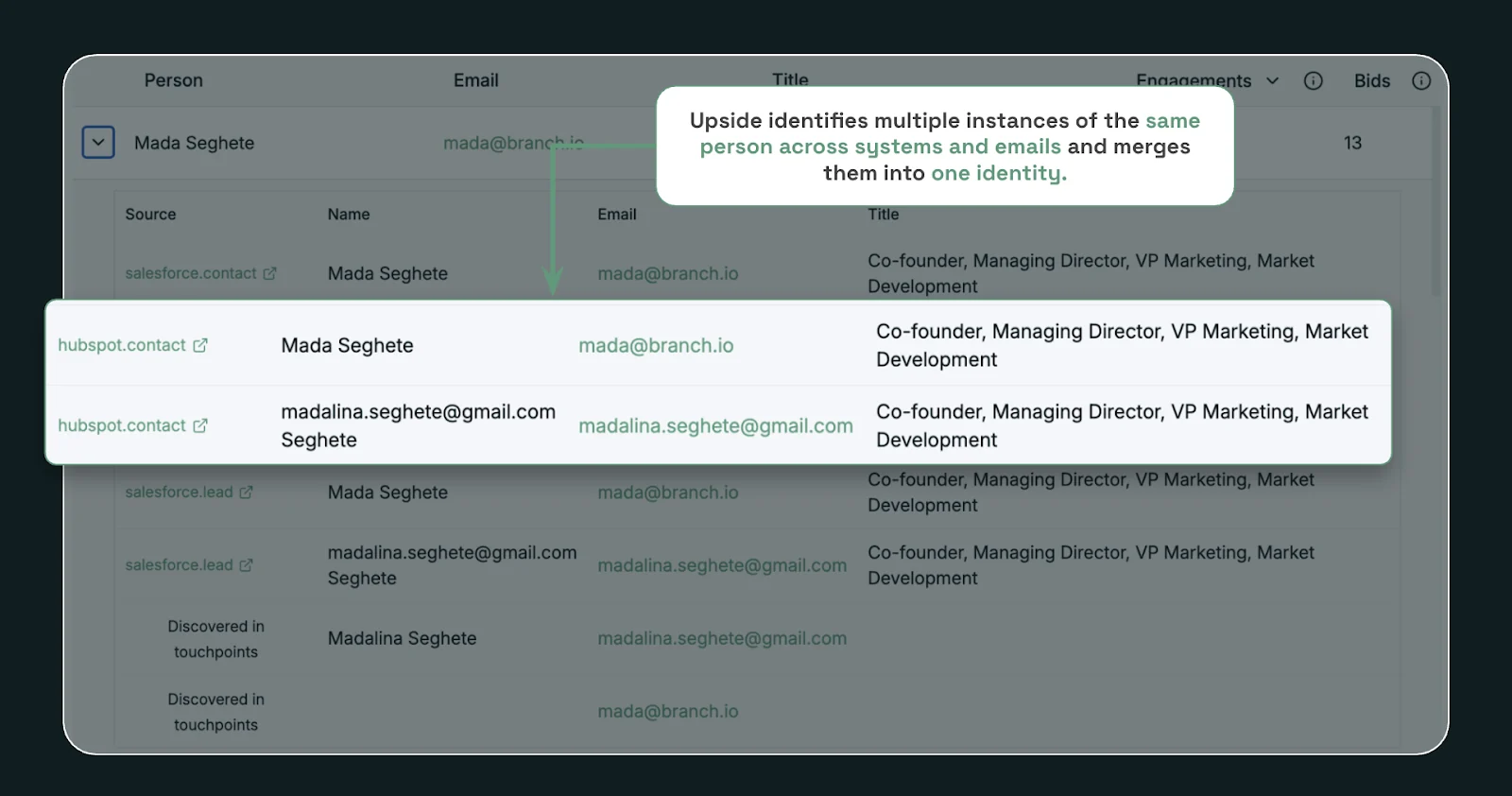
- Identity resolution55%of the people in a deal's buying group were split across three or more identity fragmentsJoins the CRM leads and contacts, marketing-automation profile, call participant and website-visitor profile that belong to the same person.Salesforce Lead, no titleUnsynced record in MAPSpeaker on 3 callsJohn OkaforVP Operations1 person
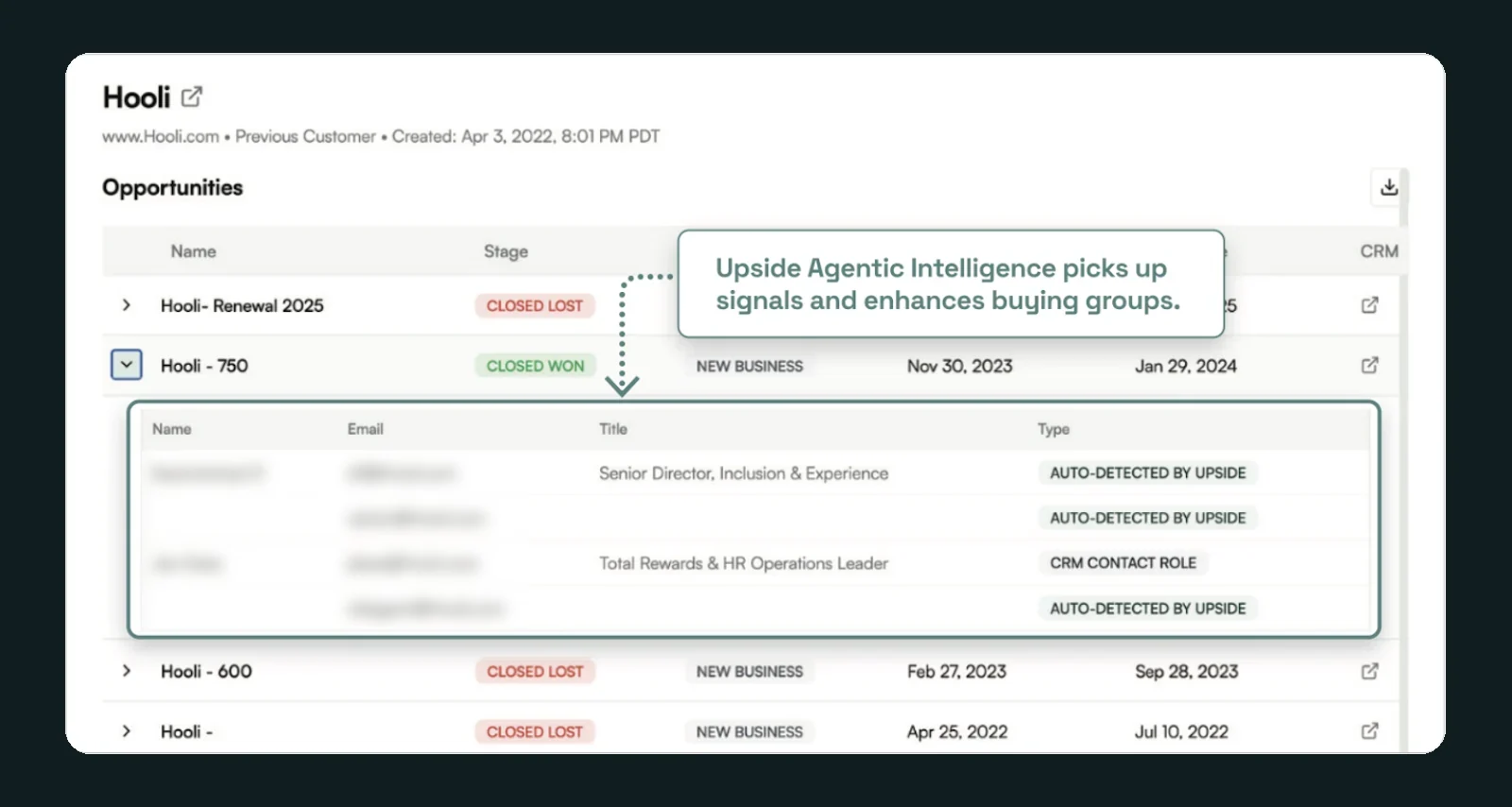
- Buying group detection1.9×as many people in a won deal's buying group before close as contact roles on the opportunity, at the typical companyAdds people outside the company who were on a one-to-one email, meeting or call with one of the opportunity's contact roles.On the opportunityJohn OkaforVP OpsJohn Okafor VP Opscontact roleDana Reyes Financefrom emailPriya Shah Securityfrom a callMarcus Hale Legalfrom an invite
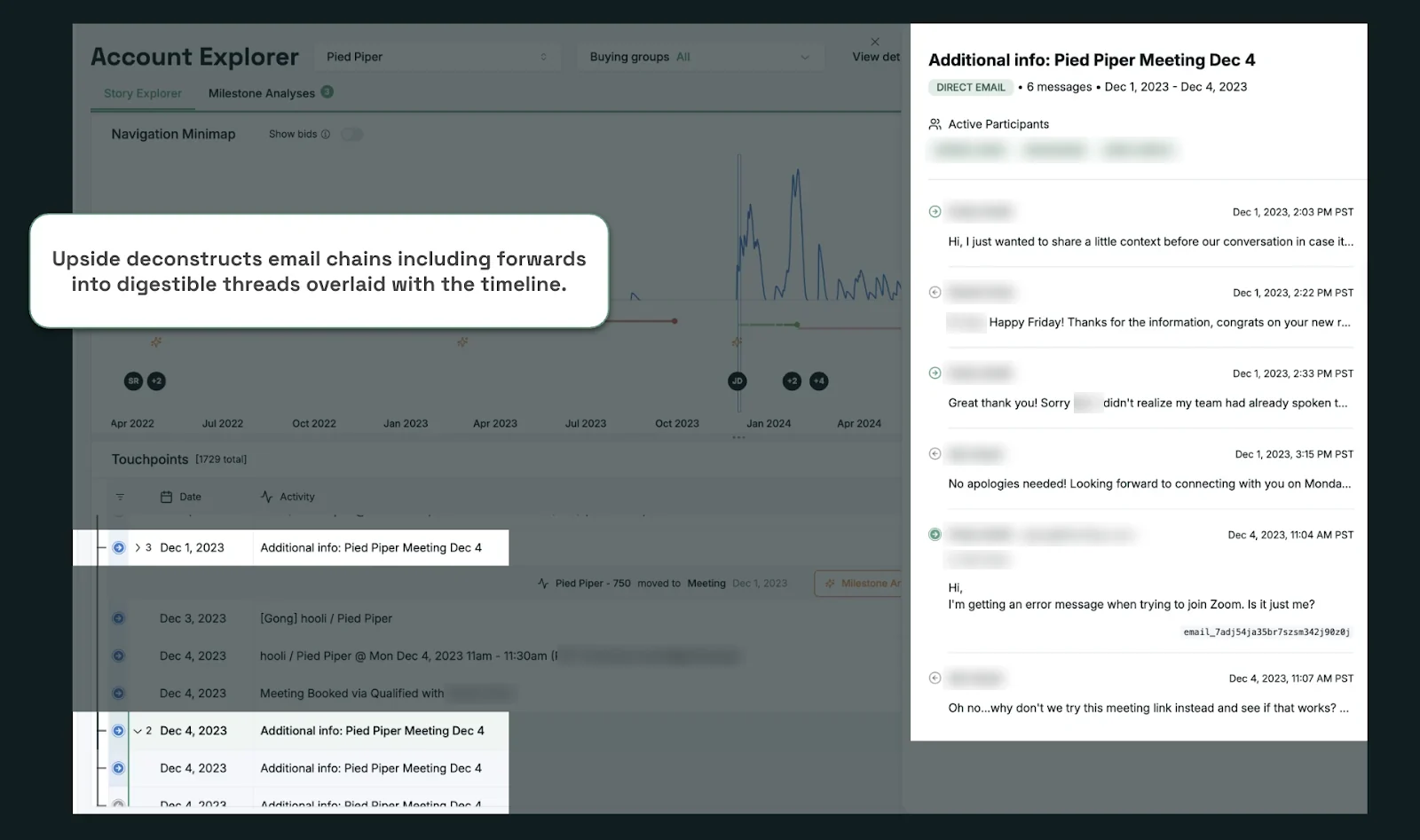
- Email thread reconstruction13%of one-to-one emails with people outside the company existed only inside another email's quoted threadUnpacks the earlier messages that a logged one-to-one email carries only as quoted text.Fwd: IntroCEO, not loggedRe: IntroAE, loggedRe: Re: Intronot logged+ 3 more repliesIntro thread6 emails, 4 people6 touchpoints
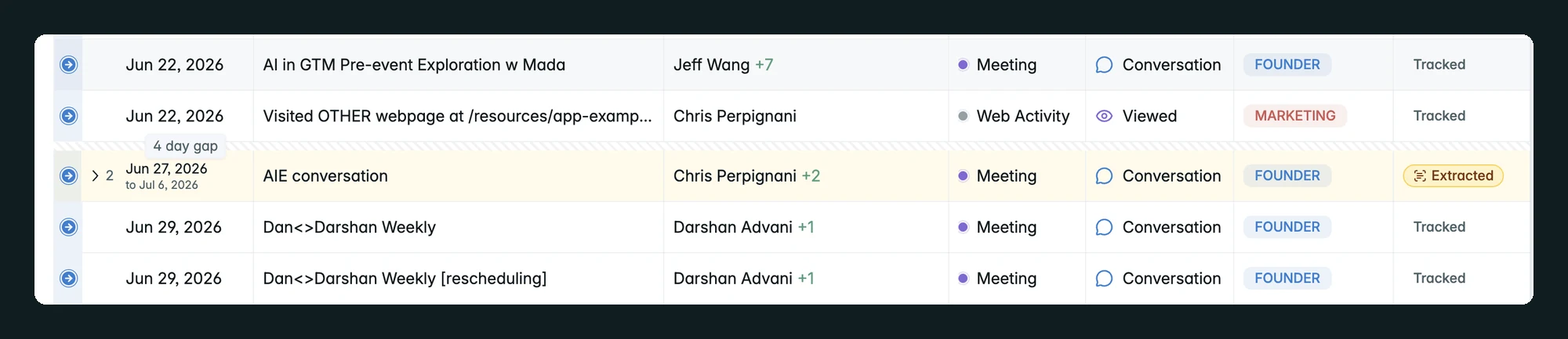
- Touchpoint recovery24%of the touchpoints the AI analysis kept were found only in emails, calls, notes or CRM textTurns a referral, an event or another interaction only mentioned in text into an AI-detected touchpoint of its own.In an email, Jan 22“…talk to Northwind…”Peer referraldated Jan 22On a call, Feb 9“…met at the roundtable…”Exec roundtabledated Feb 2
- Touchpoint deduplication11%of the activity records on a deal were extra copies of an interaction already loggedBuilt to merge copies of one interaction, in one system or several. The merge had not run here, so the copies were counted by rule.Calendar eventFeb 18Salesforce activityFeb 18Call recordingFeb 18Intro callFeb 18counted once
- Touchpoint direction43%of individual touches on accounts were the buyer engaging; the rest were the team's bidsSorts each touchpoint by who acted: the team (a bid) or the buyer (an engagement).The teambidsSentInvitedCalledThe buyerengagementsRepliedAttended
Illustrations: names, companies and dates are made up.
Identity resolution
- One person, many identity fragments. A CRM lead, a CRM contact, a marketing-automation profile and a speaker on a call can all be counted as different people, and the CRM holds only some of them.
- What Upside does
- Merges every fragment of a person into one identity, across systems and accounts, and keeps doing it as new data lands.
What we found
More than half of the people in a deal are split across three or more identity fragments.
At the typical company, 55% of the people in a deal's buying group had three or more identity fragments.
The CRM alone is not the full record:
- One in four buying-group people the CRM knows are in it two or more times (25%, against 6% of everyone in it), most often as a lead and a contact for the same person.
- 13% of buying-group people have no CRM record at all. About two in three of them are known as a participant on recorded calls, and one in three only as an email address on an email the CRM logged.
- Where two records of a person both carry a name, they disagree for 6% of buying-group people; where both carry a job title, for about one in ten (10%). A lead and a contact for the same person disagree on title 29% of the time, while the CRM contact and the marketing-automation profile almost never do. Upside uses machine learning and probabilistic models to choose the right name or title in those cases.
- 85% of buying-group people in the CRM have touchpoints from outside it: marketing automation, the call recorder, the website. Other systems rarely fill a gap in the CRM record itself: under 1% of people with no title in the CRM get one from another record.
Figure 1
Three or more fragments mark the people in a deal
Share of people, typical company
People with three or more identity fragments
Where a buying-group person's fragments sit
With two or more fragments: 78% of buying-group people, 64% of everyone in Upside.
An identity fragment is one source record of a person: a CRM contact or lead, a marketing-automation profile, a call participant or a website-visitor profile; the email address alone is not counted. Typical company: the median of the 12 companies' values. Source: Upside's analysis of the study dataset, October 2026.
Buying group detection
- The gap
- An incomplete buying committee. Reps add only a few people to the opportunity as contact roles, so many of the people who shape the deal stay out of reports and attribution.
- What Upside does
- Rebuilds the buying group from the emails, meetings and calls the contact roles share with other people at the account, including people the CRM has no record of.
What we found
In won deals, Upside found 3x more people involved than what the CRM opportunity held.
Counting everyone Upside found on a won deal, including people who appeared after it closed, won deals involved 3.3 times as many people as the CRM listed as contact roles on their opportunities at the typical company. At the typical company, the buying group active before close had 3.9 people on a won deal and 2.0 on a lost one, while the opportunity listed 1.3 and 1.1 contact roles. Comparing won and lost deals inside each company, won deals had more people at 8 of 9 companies, about two more at the middle company, and almost the same contact roles.
Of the people Upside added who had no CRM record, at the 8 companies with data, about half were first seen on a one-to-one email, a quarter on a recorded call and 6% on a meeting invite; 16% appeared only after the deal closed.
Figure 2
Won deals had about two more people in the buying group than lost deals; the contact roles were about the same
People per deal, typical company, 9 of the 12 companies
- Contact roles on the opportunity
- Buying group before close
The bars are separate medians for each group. Compared inside each company, won deals had about two more people than lost deals, and a won deal's buying group before close was 1.9 times its own contact roles.
Buying group before close: the contact roles plus the people Upside adds who had a touch between a year before the deal opened and its close; see buying group. Source: Upside's analysis of the study dataset, October 2026.
Email thread reconstruction
- The gap
- Touchpoints no one logged. When a rep logs the last email in a thread, the earlier messages, buyers' replies and forwarded intros included, come along only as quoted text. They never become CRM activities, so attribution on CRM data never sees them.
- What Upside does
- Reads the quoted history inside every email logged in the CRM and turns each earlier message into its own touchpoint, with its own sender and date.
What we found
At the typical company, about one in seven one-to-one emails existed only inside another email's quoted thread.
For emails the buyer sent, it was one in six (17%). Buyers wrote 43% of the messages Upside recovers this way, against 20% of all one-to-one emails, so recovering them brings back a large share of the buyer's side of the conversation.
One in three new-business deals (33%) had at least one email to its buying group that existed only in a quoted thread. Won deals were more likely to have one than lost deals at 9 of 12 companies, partly because won deals carry more email.
How Upside rebuilds the thread
- Read the quoted history inside every logged one-to-one email.
- Split it into separate messages, each with its own sender, recipients and date.
- Most of them are new: in this study, about 96% were a completely new record found by Upside.
- Add each one to the deal as a touchpoint from the person who wrote it.
Re: Intro and next steps
Great, I'll send the security review and pricing before Thursday's call.
Quoted below
Thanks. Our security lead will join; could the review come ahead of the call?
Great meeting yesterday. Proposing a call Thursday to walk through rollout.
Illustration by Upside Research: the commonest three-message thread, a rep's first email and the buyer's reply never logged, the rep's follow-up logged with both quoted. Names, roles and text are made up.
Figure 3
Buyers' emails are the ones most often found only in a quoted thread
One-to-one emails with people outside the company, January 2024 to October 2026, typical company
- Logged as its own record
- Found only in another email's quoted thread
Each row is the median of the 12 companies' shares, so the rows do not add up to each other. Emails with no resolved sender are in the first row only. A lower bound: a thread nobody logged leaves no trace. Source: Upside's analysis of the study dataset, October 2026.
Touchpoint recovery
- The gap
- Touchpoints hide inside other touchpoints. A referral mentioned in an email, an intro at a roundtable that comes up on a call, a peer recommendation in a CRM note: none gets a record of its own.
- What Upside does
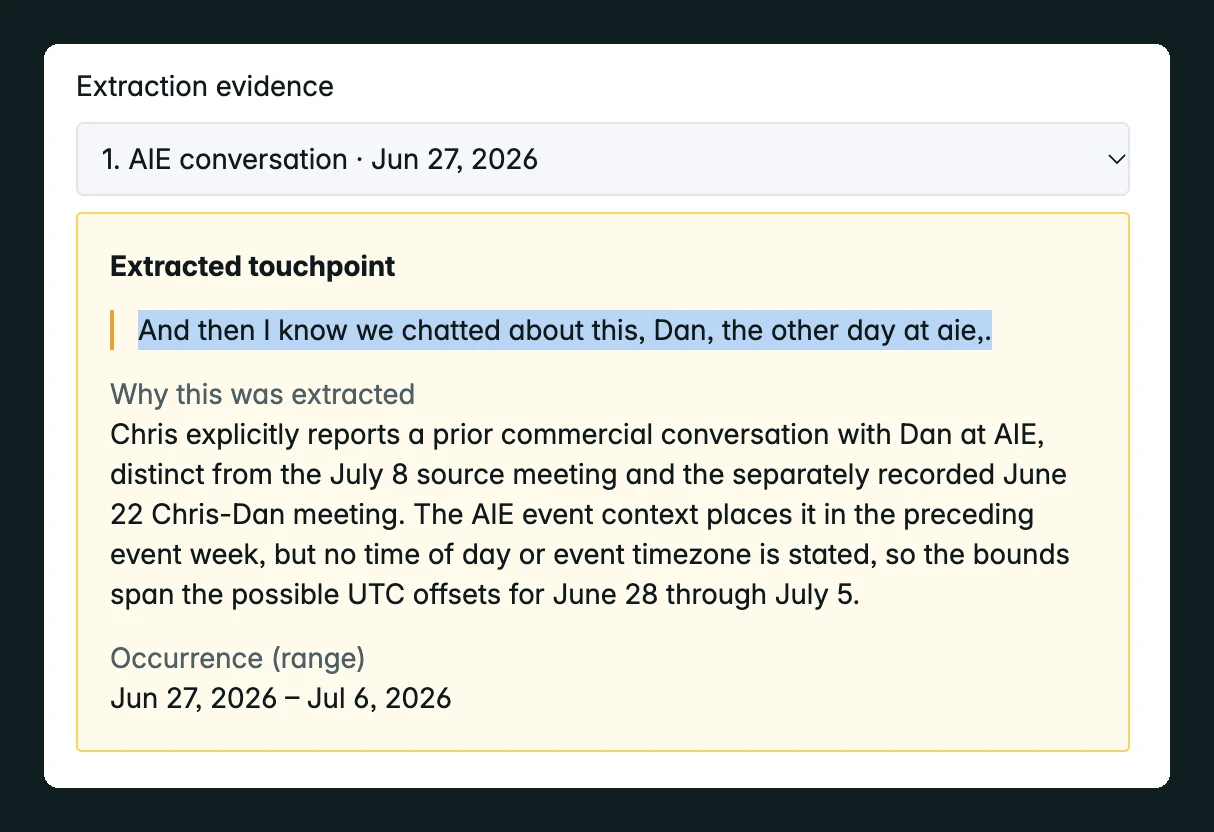
- Its AI reads the emails, call transcripts and CRM notes behind a deal, recovers those touchpoints and links each one to the evidence it came from.
What we found
On the deals Upside's AI analysed, about one in four touchpoints it kept existed only in emails, calls, notes or CRM text, and they carried 38% of the credit.
73% of those deals had at least one recovered touchpoint at the typical company. They were about half of the touchpoints that started a deal, and more so on won deals than lost ones at 10 of 12 companies.
Relationships show up almost only this way: 89% of referral touchpoints, and every peer recommendation, were found in unstructured data rather than in a record.
Figure 4
Touchpoints found only in unstructured data weigh more than their number
AI-detected touchpoints found only in emails, calls, notes or CRM text, as a share of each, deals analysed by Upside's AI, typical company
AI-detected multi-touch on each deal's latest analysis; touchpoints where the buyer only responded are left out. Deals customers chose to analyse, not a random sample. Source: Upside's AI analysis of the study dataset, October 2026.
Touchpoint deduplication
- The gap
- Activity counted wrong. The same interaction is logged in several systems, or several times in one, and each copy counts as its own touchpoint.
- What Upside does
- Is built to recognize those copies as one touchpoint. That merge had not run for any of the 12 companies, so this section counts the copies.
What we found
At the typical company, one activity record in nine on a deal was an extra copy of an interaction already logged.
Meetings and calls were copied most, logged twice in the CRM or in the CRM and the call recorder, then campaign responses kept in both the CRM and the marketing-automation tool. Merging changes how much activity a deal shows, not the comparison between won and lost deals.
The copies also disagree on when things happened. One in five CRM meetings and calls with a recording of the same person carries a date more than a day off the recording, or no time of day. The CRM date falls both before and after the recording, more often before, so this looks like the rep's entry and the recording disagreeing rather than a sync delay; how long after an activity the CRM record was created could not be measured. Upside keeps each source's own date, so the recording's time sits next to the rep's entry.
Figure 5
Meetings and calls see the most duplication of any touchpoint
Share of each activity type's records that were extra copies of an interaction already logged, new-business deals, typical company
Copies counted with the rules under duplicates, not by Upside's product. Bulk marketing email is not shown: each company sends it from one system, so it cannot be copied across systems. Web page views: 11 companies. Source: Upside's analysis of the study dataset, October 2026.
Touchpoint direction
- The gap
- Effort counted as interest. A sent email counts the same as a reply, so the team's effort looks like the buyer's interest.
- What Upside does
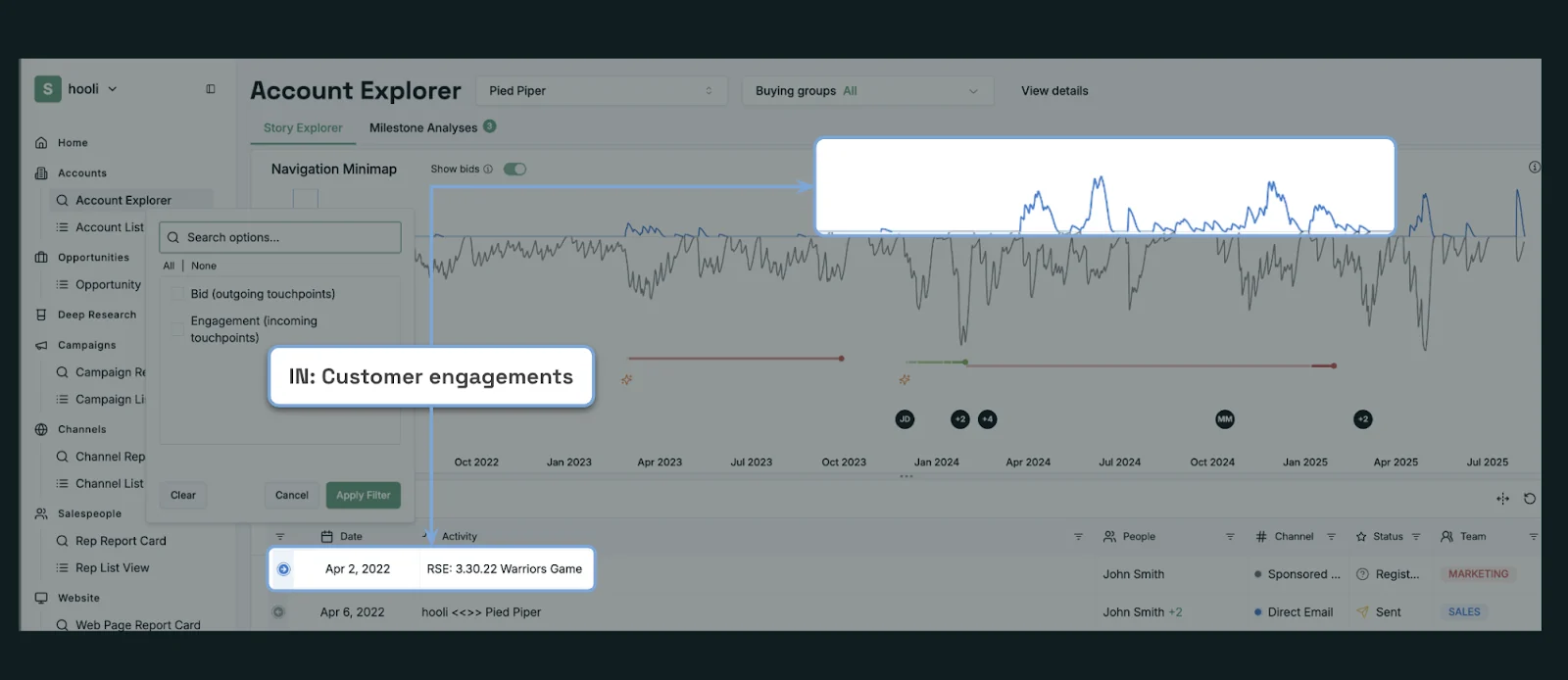
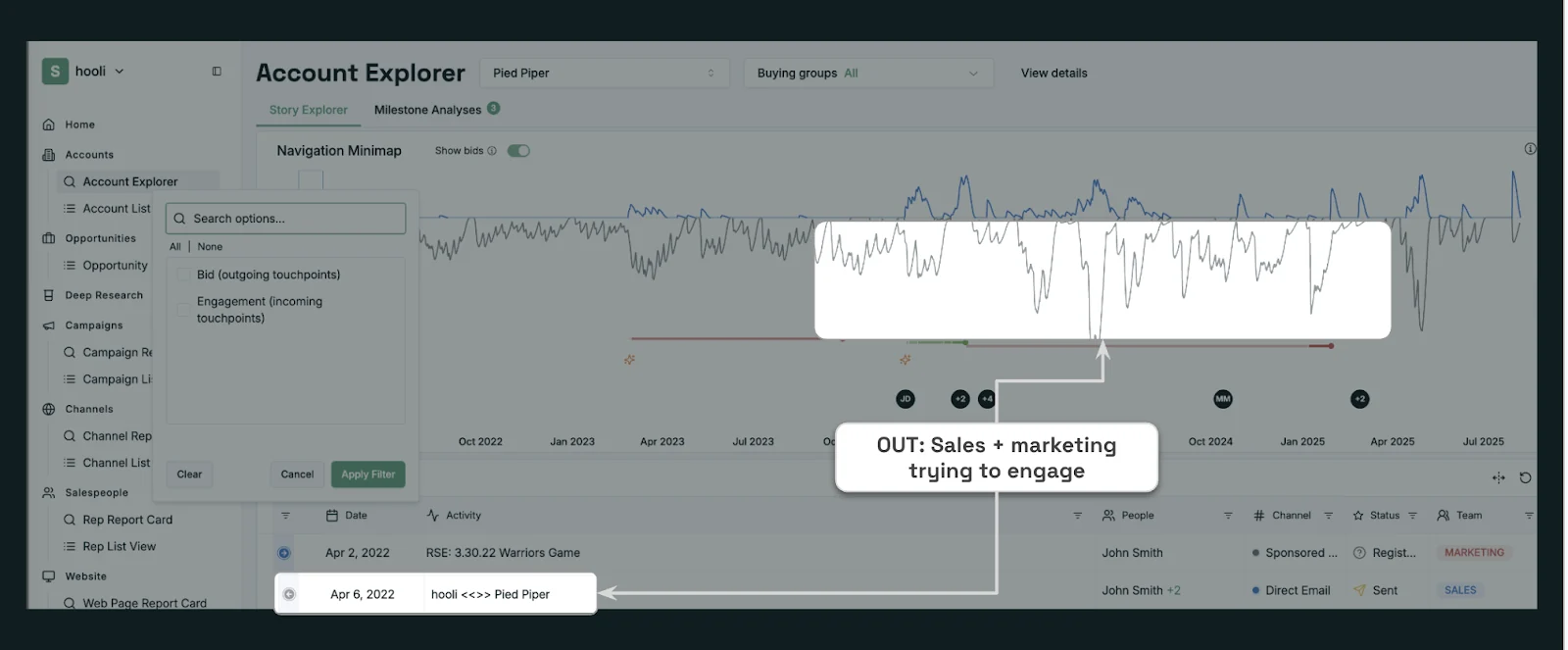
- Classifies every touchpoint as a bid to the buyer, something the team did (sent, invited, called), or an engagement from the buyer, something the buyer did (replied, met, picked up, clicked).
What we found
Before a deal existed, contacts at the account got on average the same number of bids from the team. Buyers on won deals answered more.
Most touches are the team reaching out. At the typical company, 43% of all touches on accounts in the last year were marketing-email sends and 16% other bids, against 23% engagements from the buyer.
In the year before a deal was opened, the middle deal saw about five bids whether it was later won or lost. Buyers on won deals answered with 5.0 engagements, on lost deals 2.5. Inside each company, won deals had about two more engagements than lost deals (at 8 of 12 companies) and no more bids. Won deals were not chased harder beforehand; their buyers answered more.
The gap lasts: over the last 12 months, the buyer's share of individual touches was 6.7 points higher on accounts that won than on accounts that only lost at the same company, at 11 of 12 companies, though that window includes activity after the sale.
Most outreach goes unanswered: buyers replied to 13% of the email threads a seller started, and clicked 1.1% of marketing emails.
Figure 6
Before the deal opened, won and lost deals got the same bids; buyers on won deals answered with about two more engagements
Touches on the deal's account in the year before it opened, the middle deal at the typical company
- Bids from the team
- Engagements from the buyer
The bars are separate medians for each group. Compared inside each company, won deals had about two more engagements than lost deals and no more bids.
Individual touches: one-to-one emails, meetings, calls, CRM campaign memberships, form fills and ad clicks; marketing-email sends, ad impressions and page views are left out. A meeting with a buyer on it counts as an engagement. New-business deals opened since January 2025 with a full year of history before them. Source: Upside's analysis of the study dataset, October 2026.
What we found critical
These are the steps that mattered most while building the data behind this study. Most hold for any team, with or without Upside.
Contact roles are not enough to understand buying groups
On won deals at the typical company, the buying group active before close had about 1.3 more people than the contact roles. We build the buying group from activity instead: people who shared an email, a meeting or a call with a contact role. The tradeoff: someone who never did any of those stays invisible, and a deal with no contact role gets no buying group at all.
Start with a weekly list of people at the account who emailed or met the deal team since the deal opened and aren't on the opportunity.
One buyer was spread across several records
One in four buying-group people the CRM knows were in it two or more times. We merge records on the email address before counting anything. The tradeoff: a buyer who changes jobs or writes from a personal address can still end up split in two.
Merge each lead into the contact with the same email address, and report on people, not records.
Buyers' answers were hiding in quoted threads
Buyers wrote 43% of the messages that existed only as quoted text inside a later email. We split every quoted message out as its own touchpoint, as in the steps above. The tradeoff: a reply that was never logged and never quoted stays invisible.
Sync every rep's mailbox to the CRM, so each buyer reply is logged as an email of its own, not only as quoted text under the rep's last message.
How we measured
- Companies
- 12 B2B companies that use Upside, as of 29 October 2026. Each company's data was anonymized and aggregated on its own; no number or figure identifies a company or a person, and no figure uses data from fewer than 3 companies.
- Deals
- New-business opportunities created from 1 January 2025 with a full year of CRM and email history before them: about 59% of all the new-business opportunities created in that time across the 12 companies (every one at nine of them), because two companies' email sync reached full volume only in late 2025. Renewals and expansions are not counted. Requalified deals, at two companies, are left out of won-versus-lost comparisons. All data was aggregated and anonymized before being blended.
- Typical company
- The median of the companies' values. Every other share in this brief is the typical company's, because a few very large companies dominate any all-company total. Won and lost deals are compared inside each company: the median across companies of won minus lost (or of won divided by lost, for the ratios), with the number of companies where won came out ahead.
- Opportunity
- The deal's record in the CRM. The people on it are its contact roles.
- Buying group
- Contact roles on the opportunity, plus the people Upside detects as part of the real buying group.
- Identity fragments
- Source records of one person merged into one identity: a CRM contact or lead, a marketing-automation profile, a call participant or a website-visitor profile. The bare email address is not a fragment. The CRM is each company's own system of record.
- Emails
- One-to-one emails with at least one person outside the company, from January 2024. An email counts as found only in a thread when it exists only in the quoted history of another logged email; the 4% of those that match a logged email are left in.
- Recovered touchpoints
- Touchpoints Upside's AI found only inside an email, a call transcript, a CRM note or other CRM text, with no record of their own, on each deal's latest AI analysis, as described in The Untracked Half.
- Duplicates
- Upside detected duplicates of the same touchpoint found in multiple records.
- Dates
- A CRM meeting or call is compared with the nearest call recording of the same person within 3 days. Larger gaps are not seen, and a person with two conversations within a few days can be matched to the wrong recording, so the share is approximate. How long after an activity the CRM record was created could not be measured.
- Direction
- An engagement is a touch where the buyer acted: replied, attended, answered, clicked, filled a form or visited. A bid is a touch where only the company acted. Individual touches are one-to-one emails, meetings, calls, CRM campaign memberships, form fills and ad clicks; marketing-email sends, ad impressions and page views are left out of the shares. Figure 6 counts touches on the deal's account in the 365 days before the deal opened. The 12-month account view labels accounts by their new-business deals created since January 2025.